
How the 2026 FIFA World Cup Was Delivered to the World: Inside the Broadcast Network Behind 104 Matches
The 2026 FIFA World Cup was the most complex broadcast project in sports history. Here is how host broadcasters built a continent-spanning fibre network, centralised production in a Dallas nerve centre, and delivered every match to 180-plus media companies worldwide.
When the 2026 FIFA World Cup final whistle blew, more than a billion people around the world watched it happen live. What almost none of them saw was the extraordinary technical machine that carried the picture from the pitch to their screens. Behind every pass and every goal sat one of the largest and most ambitious broadcast networks ever assembled for a single event—a continent-spanning system of cameras, fibre, servers, and software that turned 104 football matches into a seamless global broadcast.
The 2026 tournament was unlike any before it. For the first time, the World Cup was co-hosted by three countries—Canada, the United States, and Mexico—across 16 host cities, four time zones, and an expanded field of 48 teams. Delivering all of that to more than 220 territories worldwide was, by any measure, the most complex broadcast project in the history of sport. Here is how it was built, and how the games actually reached the media companies that brought them to your living room.
A Tournament Built for Broadcast
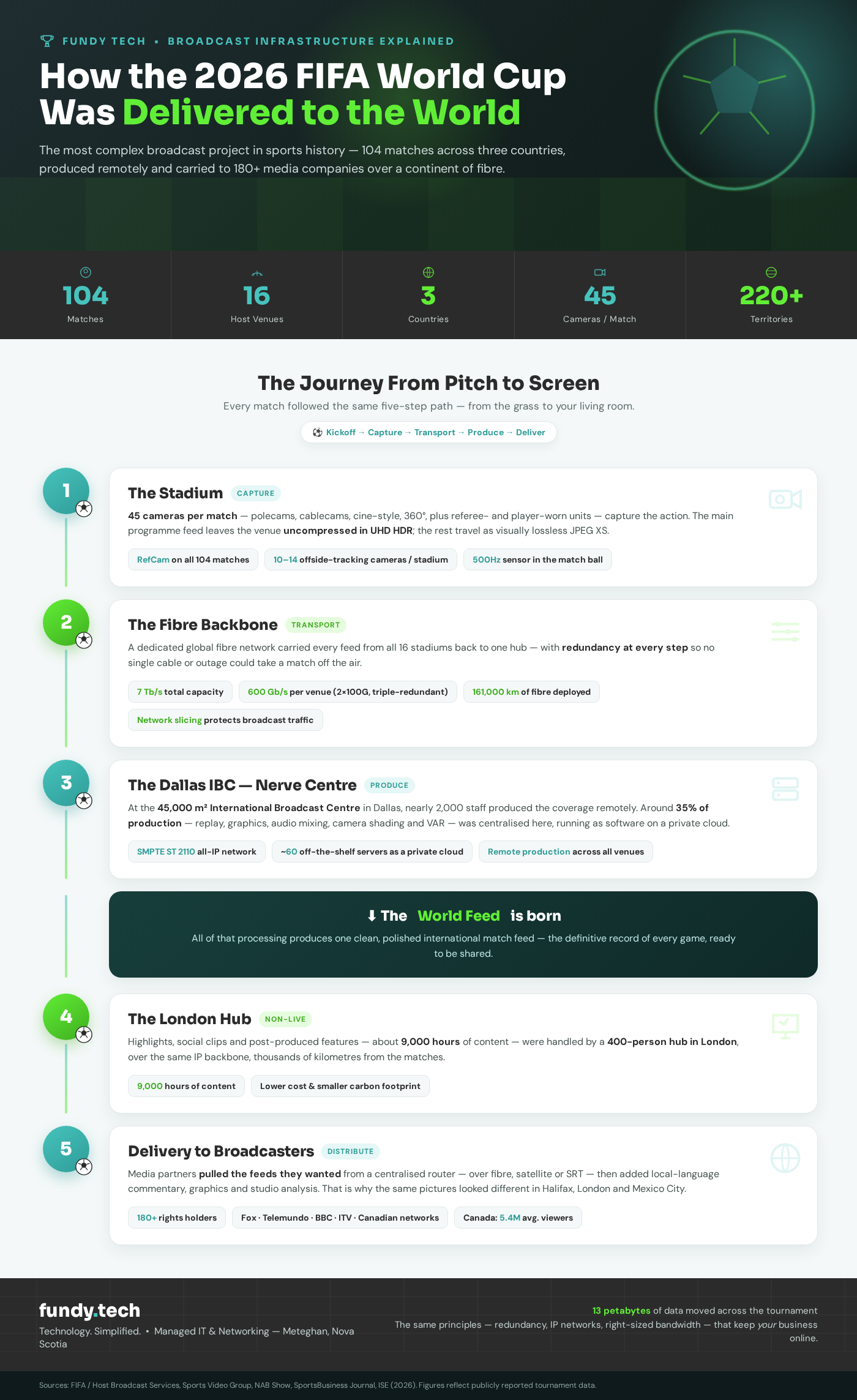
The numbers alone are staggering. The tournament produced roughly 9,000 hours of content, moved an estimated 13 petabytes of data across its networks (that is 13 million gigabytes), and relied on some 161,000 kilometres of deployed fibre-optic cabling—enough to circle the Earth four times over. Coordinating 104 matches spread across a continent meant engineers could not rely on the old model of parking a fleet of production trucks outside each stadium. They needed something fundamentally new.
The answer was a centralised, IP-based production model: instead of building a complete broadcast operation at every venue, the host broadcaster pulled the signals from all 16 stadiums back to a single nerve centre and produced the coverage remotely. It is a philosophy that quietly mirrors what modern businesses already do with cloud computing—concentrate the expensive, specialised work in one well-managed location, and connect to it over a fast, reliable network.
The Stadium: Where the Signal Begins
Every broadcast starts on the grass. Host Broadcast Services (HBS), the FIFA-owned company responsible for producing the world feed, deployed a baseline of 45 cameras for every single match—scaling up further from the knockout rounds with additional ultra-motion and super-slow-motion units. The camera plan went far beyond the traditional row of sideline lenses: polecams, cablecams gliding above the pitch, cine-style cameras with cinematic depth of field, 360-degree rigs, and player- and referee-worn cameras all fed the production.
A few of the technologies working quietly in the background:
- RefCam ("Referee View") was deployed across all 104 matches, using AI-powered stabilisation to cut motion blur by up to 50 percent and put viewers right in the middle of the action.
- Semi-Automated Offside Technology (SAOT) used 10 to 14 dedicated tracking cameras per stadium to map 29 skeletal points on every player, feeding the video assistant referee system.
- A 500Hz sensor inside the official match ball added precise kick-point data to those offside and replay decisions.
On-site, each venue kept its match director and camera operators—the creative eyes of the broadcast. But the raw feeds they captured were immediately sent elsewhere for the heavy lifting. The primary programme feed, known as the Extended Stadium Feed, left the stadium uncompressed in UHD HDR to preserve maximum image quality, while the dozens of additional isolated camera feeds were compressed using JPEG XS at a roughly 10:1 ratio—visually lossless, but light enough to move hundreds of feeds at once.
The Fibre Backbone: Moving the Game
Getting all of that video from 16 stadiums to a single location required a network of almost unimaginable scale. The tournament's telecommunications partner built a dedicated global fibre network delivering roughly 7 terabits per second of total capacity back to the central broadcast hub.
Each stadium was connected with around 600 gigabits per second of contribution capacity, structured as two 100-gigabit paths with triple-redundant routing. That redundancy is the part worth pausing on: at no point could a single cut cable, failed switch, or provider outage be allowed to take a match off the air. Every critical path had a backup, and the backups had backups.
Inside and around the venues, the challenge was just as intense. Each stadium behaved like a temporary smart city, with private 5G networks, thousands of antennas, and network slicing—a technique that carves a shared network into dedicated lanes so that mission-critical broadcast traffic, public-safety communications, and 80,000 fans posting videos never compete for the same bandwidth. Some venues moved more than 50 terabytes of data on a single match day.
The Dallas IBC: The Nerve Centre
All of those fibre paths converged on the International Broadcast Centre (IBC) in Dallas, Texas—a 45,000-square-metre facility inside the Kay Bailey Hutchison Convention Center that housed nearly 2,000 broadcast personnel. This was the brain of the entire operation.
What made 2026 historic was how much production moved here. Roughly 35 percent of the work that used to happen at each stadium—instant replay, graphics insertion, audio mixing, and camera shading (the fine colour and exposure balancing of every camera)—was performed remotely from Dallas. A single team of the world's best replay operators could work multiple matches in different cities, one after another, without ever leaving the building.
Crucially, this was not a room full of traditional broadcast hardware. The IBC ran as a software-defined private cloud, built on roughly 60 high-performance commercial off-the-shelf servers and a converged SMPTE ST 2110 IP network—the same open standard that carries video, audio, and data as synchronised streams over ordinary IP infrastructure. Multiviewers, encoders, format conversion, and HDR-to-SDR translation all ran as software, spun up and reconfigured on demand. The video assistant referee operation was run from here too, fed by those SAOT cameras and the sensor in the ball.
The output of all this was the world feed: the clean, polished international match feed that represents the definitive record of each game.
The London Hub: Non-Live Content
Not everything needs to be live. To handle the enormous volume of highlights, social clips, and post-produced features—around 9,000 hours in total—HBS ran a separate 400-person non-live hub in London, at the Here East campus in Stratford. Keeping this work in the UK avoided flying hundreds of editors across the Atlantic, tapped an existing pool of production talent, and meaningfully reduced the tournament's carbon footprint. Highlights and social content flowed over the same IP backbone, produced thousands of kilometres from where the matches were played.
The Last Mile: Delivering to the Broadcasters
Here is the part that answers the real question—how did the games get from that Dallas nerve centre to Fox, Telemundo, the BBC, ITV, and the roughly 180-plus rights holders serving more than 220 territories?
Once the world feed was produced, it was made available through a centralised router panel at the IBC. Rather than shipping a fixed channel to each broadcaster, the system let media partners pull the specific feeds they wanted—the main programme feed, individual isolated cameras, tactical feeds, data, and audio—directly into their own regional workflows. Distribution went out over a mix of dedicated fibre, satellite, and SRT (a secure, internet-based transport protocol), giving every partner a path suited to their location and budget.
From there, each broadcaster added its own layer. A rights holder would take the clean world feed and wrap it with local-language commentary, regional graphics, studio analysis, and advertising before sending it on to viewers. That is why a match looked and sounded different in Halifax than it did in London or Mexico City, even though every one of those broadcasts began with the exact same pictures produced in Dallas. In Canada, that reach translated into an average audience of 5.4 million viewers across linear and streaming platforms, with an 82.6 percent share on national linear channels during the country's matches.
Why This Model Is the Real Legacy
Ask the engineers who built it, and many will tell you the lasting story of 2026 was not any single camera or gadget—it was the proof that large-scale remote, decentralised production works. Concentrating specialists in one hub, connecting to venues over redundant IP fibre, and running the whole operation in software rather than bespoke hardware delivered consistent quality, lower costs, less travel, and a smaller environmental footprint. It is a blueprint the broadcast industry will follow for years.
What a Nova Scotia Business Can Take From a World Cup
A continental broadcast network and a small business in Clare or Yarmouth might seem worlds apart, but the engineering principles that carried the World Cup are exactly the ones we build for local organisations every day at Fundy Tech—just at a different scale.
- Redundancy keeps you on the air. The tournament never trusted a single cable or provider. Your business shouldn't rely on a single internet line either. A well-designed network with failover keeps you working when a line goes down.
- Centralise the hard work, connect over a good network. Remote production is cloud thinking. The same logic lets a Meteghan clinic or a Digby tourism operator run their software centrally and work securely from anywhere—provided the network underneath is fast and reliable.
- Right-size your bandwidth and protect the important traffic. Network slicing kept broadcast feeds safe from fan traffic. In your office, the same idea—separating guest Wi-Fi, payment systems, and staff devices—protects the connections your business actually depends on.
- Build on standards, not lock-in. The World Cup ran on open IP standards and off-the-shelf servers. Businesses benefit from the same approach: reliable, well-supported technology you own and can grow, without being trapped by a single vendor.
The World Cup showed what is possible when a network is designed properly from the ground up. Whether you are broadcasting to a billion people or simply trying to keep a busy office online through a Nova Scotia winter, the fundamentals are the same: plan for failure, build in redundancy, and treat your network as the critical infrastructure it is.
If your business network could use that kind of thinking, we would love to help. Book a free consultation with Fundy Tech, or call us at 902-334-5872. Technology, simplified.
Talk to a local IT partner.
Based in Meteghan, serving Clare, Yarmouth, Digby, and businesses across Atlantic Canada.
Related reading
Networking
Storm-Proof Your Business Network: Power Backup and Failover Strategies for Atlantic Canada SMBs
Atlantic Canada's storms and power outages are a seasonal reality for small businesses. Learn how smart power backup, dual internet connections, and business-grade network design can keep your office online when the weather turns.
Read articleNetworking
Wi-Fi 7 for Small Businesses: Why Upgrading Your Nova Scotia Office Network Makes Sense in 2026
Nova Scotia now offers near-universal high-speed internet, but your office Wi-Fi may still be the bottleneck. Wi-Fi 7 brings lower latency, higher capacity, and cleaner spectrum — if you upgrade with a plan.
Read articleNetworking
Business Wi-Fi That Works: Why Nova Scotia Small Businesses Can No Longer Afford Patchwork Networks
Outdated wireless networks cost Nova Scotia small businesses hours of productivity every week. Learn how modern business Wi-Fi improves speed, security, and reliability—and why professional network design matters more than ever.
Read article